Saturday, 6 April 2019

A quarter of the year is over and just beginning work on my 1st blog for 2019...I'm becoming a bit slower out of the blocks!

The theme for this one is something that is many things, cultural, naval, penal, used to be more outsider, now getting to be more mainstream, almost standard practice, where it wasn't quite so before.
The Art of the Tattoo.

Tattooing is body modification, where a design is made by inserting ink or dyes into the dermis layer of the skin to change the pigment.
Ouch! No wonder pain is involved.

I guess it provided something to do on those long sea voyages.

Tattooing has a long history. Humans have been fascinated with applying permanent designs on their skin for millennia.
In 1991 Otzi the Iceman, was found in the Otzal Alps (mountain range in Central Eastern Alps in State of Tyrol, Southern Austria & province of South Tyrol, Northern Italy). Recorded at 5,300 year old, Otzi had a total of 61 tattoos, with the majority on his legs. Soot or fireplace ash were used to create the markings.
If you would like to know a little more about Otzi's tattoos, check out this 'Science for the Curious' link.
http://blogs.discovermagazine.com/d-brief/2015/01/30/scientists-mapped-otzi-icemans-61-tattoos/#.XJa5c_xMTcc

Tattoos can be:
  • purely decorative (no specific meaning)
  • symbolic (specific meaning pertinent to the wearer)
  • pictorial (depiction of specific person or item)
  • identification (a form of branding)

The word "Tattoo" came into European usage in the 18th Century. It is derived from a Polynesian word "tatau", meaning "to strike". Tattooing is a strong cultural element throughout all of Polynesia.

The Pe'a taditional male tatau of Samoa covers the body from the waist to the knees. It is an extremely painful and culturally ritualised procedure, an ordeal not to be lightly undergone.
This is a very informative website, explaining in-depth the history, method and patterns of Polynesian tattooing.
http://www.zealandtattoo.co.nz/tattoo-styles/polynesian-tattoo-history-meanings-traditional-designs/

Malu is the traditional female tattoo of Samoa.

This link will take you to a great account of a Samoan woman's experience with Malu. She is sharing her story. I noticed the Malu on a young Samoan student at school a few years back. It was quite stunning and I remember thinking how strong she was to have endured the pain of such a procedure.
https://asiapacificreport.nz/2017/03/26/celebrating-pasifika-the-art-of-samoan-female-tattooing/


If you have looked at the 'Polynesian tattoo history' site you will have noticed Ta Moko is also covered. Ta Moko, the tattooing of the face and body by Maori. In pre-European time, it was the most high ranking Maori who received moko, and those without were considered of lower social rank. Historically, the skin was carved out with chisels, which left it grooved. Men received moko on their faces, buttocks and thighs. Women usually were tattooed on their lips and chins.
Since 1990 there has been a resurgence in Ta Moko due to the strong revival of the language and cultural practice.

This is a lovely documentary about the last of the kuia with moko. It is astounding what ages some of these wonderful old women were.
https://www.nzonscreen.com/title/into-antiquity-memory-maori-moko-1971

and this one is about contemporary Maori women who are choosing to have moko. It is about the importance of identity and symbolism.
https://broadly.vice.com/en_us/article/9k95ey/its-transformative-maori-women-talk-about-their-sacred-chin-tattoos
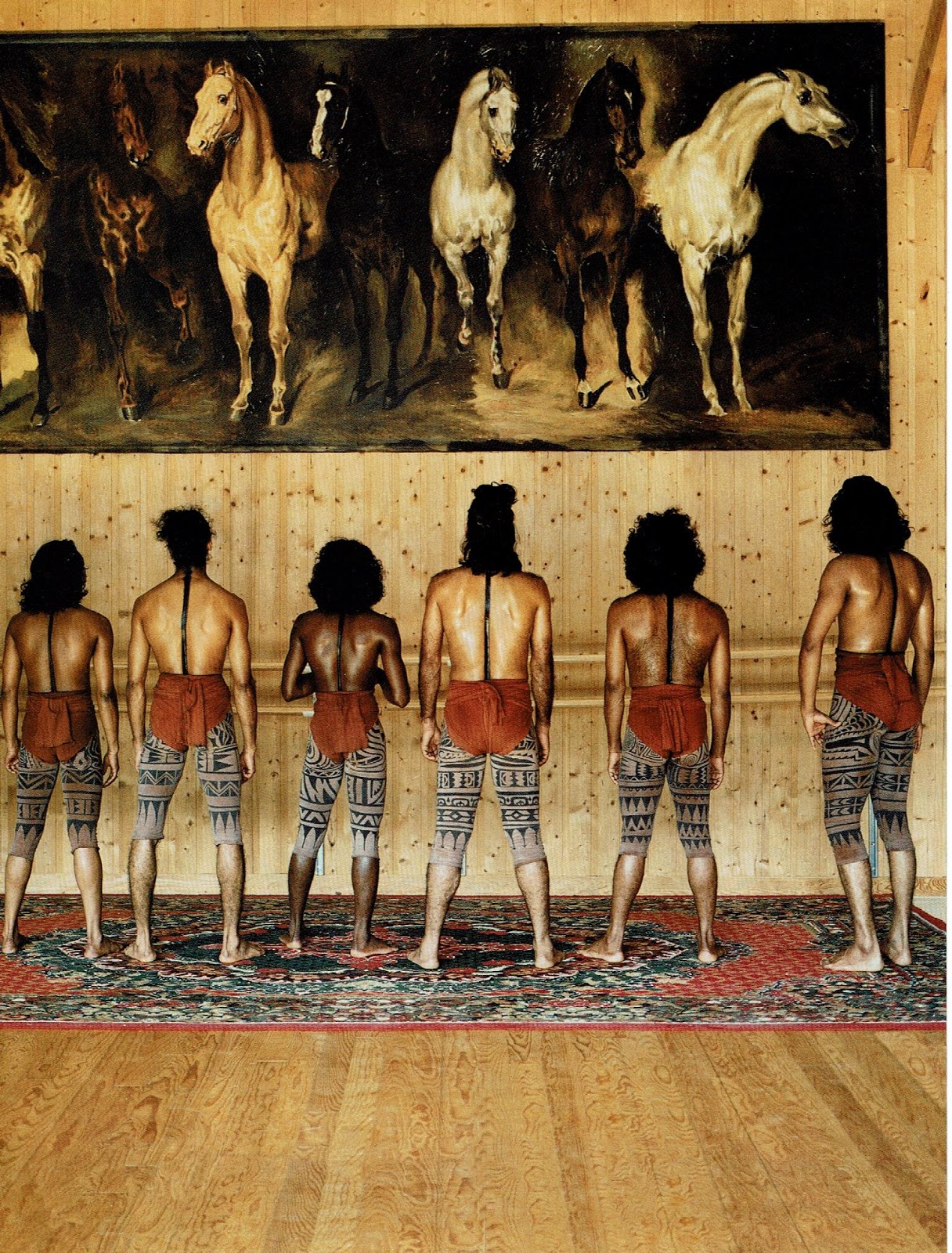
A wonderful image from a Paris Vogue of years ago. I have very little information about it,  always thought it could be a Polynesian dance company, but who knows. I really like the tattoo patterned tights.
Sometimes this sort of clothing is not seen as acceptable, especially if the designer doesn't get it right. Here is an example of not getting it right.......
The issue is Nike releasing a set of women's sports gear (2013), with the leggings having the appearance of the Samoan Pe'a, which is reserved for men. Apparently Nike's response was:"These tights feature a distinctive black and white print inspired by tattoos from the southwest Pacific - Fiji, Samoa, New Zealand - with flattering, hand-drawn graphics celebrating the stories culture of Oceana (sic)." A case of cultural misappropriation I think...what do you think? 
Cultural appropriation or misappropriation is the adoption of elements of one culture by members of another culture. It becomes controversial when members of a dominant culture appropriate from disadvantaged minority cultures. If you wish to know more, read the information on this site.

Some designers do get it right....like Issey Miyake, in his seminal "Tattoo" Spring/Summer 1970 collection, which included a dress and bodysuit incorporating Janis Joplin and Jimi Hendrix. Consider, Janis and Jimi were both recently deceased.

The style of Miyake's print design is based on tattoos closely associated with Yakuza, an organised Japanese crime syndicate (the Japanese Mafia). Yakuza male members often have heavily tattooed bodies.
 Issey worked with Yakuza images when he promoted his collection
 In this collection Issey Miyake demonstrated a re-invigoration of the traditional Japanese tattoo craft of irezumi, meaning "insertion of ink". Initially used as a branding of prostitutes, prisoners and outlaws, irezumi was then adopted by lower social strata, outsiders. "Insertion of ink" became a symbol of rebellion.
Want to see the ways they branded criminals, go onto this website.
http://www.iromegane.com/japan/culture/history-of-japanese-tattoo/

A cool image expressing Issey's A/W 1989/90 Tattoo Body. What glorious bodysuits.


In his 1992 Spring/Summer collection, Issey designed another Tattoo Body. Isn't it beautiful. Reminiscent of Ozti's patterns.
I like the patterns of the lines. 
It's taking me to another cultural tattoo, which is experiencing a revival, especially among the women, The Inuit.  The Inuit are the indigenous people inhabiting the Artic regions of Greenland, Canada and Alaska.
They had 2 traditional tattooing methods:-
1) Hand-poking, where a hand held stick tool and image created one dot at a time.
2) Skin-stitching, where a needle was used to sew trails of ink with thread under the skin
Image of skin-stitching. I go spare when I see students doing anything like this!
In skin-stitching the tattoo is sewn into the skin with needle and thread, originally bone and hair, as discovered by the first Europeans who came into the lives of the Inuit in 1700. The thread was covered in a chosen material to create the pigmentation, like black soot from an oil lamp. The thread might have been left in the skin for a couple of days, before being removed ensuring the tattoo pattern would remain.
This website will give you a good insight into what the revitalization of this culture of tattooing means to the Inuit women who are maintaining it. 

The skin-stitching of the Inuit makes me think of "scarification", which is the scratching or cutting of designs into the skin. It was/is a traditional method for the negroid people of Africa, because tattooing did not prove to have a prominent effect on their dark skin.

In my 7th blog I refer to a student who took 'scarification' as an inspiration for her Yr. 12 Fab.Tech. project. It was such a cool concept she developed. Take this site and scroll down a bit, you'll come to it. I think it's great.

Now, back to Issey Miyake's first Tattoo Body and the connection with Janis Joplin.
Janis Joplin was one of the first female muso stars who had tattoos. I actually thought she had 'PEARL' tattooed across her heart, but not so. Don't know where I got that idea.
It is this wrist tattoo and a tiny heart.
This is her cool Pearl album cover, the wrist tat is visible, as is the ciggie and the glass of...I always thought Southern Comfit was her tipple, again, I could be mistaken...I like the outline of her thigh under her skirt, such a 'hippy chick'.
She looks so young in this shot, she probably was so young.
Something about it reminds me of that classic shot of Jodie Foster in Taxi Driver...
maybe it's something to do with vulnerability.

Want a trip back? Take this link to hear the songs from Pearl.

and if I'm going to be writing about Janis Joplin, well, I just have to include her encounter with Leonard Cohen in the infamous Chelsea Hotel

Connecting to my tattoo theme is via the likes of these, as I don't think L.C. had any tattoos himself...again, correct me if I am wrong, please.


As mentioned previously, clothing designers gain a lot of inspiration from tattoos.
This is Martin Margiela S/S 1989
and Jean Paul Gaultier S/S 1994
 

And of course CdG...
Comme des Garcons Homme A/W 2015 collection featured a collaboration with fascinating tattoo artist Joseph Ari Aloi aka jk5.
Rei Kawakubo took his sketchbooks telling him CdG would have full creative control over what was used and how. 
The result being...

Of course RK will always deliver the aesthetic of the collection in a very wearable t-shirt
jk5 is an interesting guy, as revealed in this videoed talk he delivered following the publication of one of his books. He found the CdG experience quite emotional, which I can understand.

CdG S/S 2019 RTW collection was described as one of self-criticism instigated by "internalised female psychological conditioning" (Sarah Mower). Be that as it may (I may discuss it in a future blog), but what I am taken with are the tattoo like patterns that appear on some of the under garments.


The tattoo style is very obvious in the fabric used to construct these tops..


This is the closest I come to anything like a tattoo t-shirt in my wardrobe. I'm inspired to make an outer garment I can wear it under, such as the red smock shown above.

Junya Watanabe CdG delivered a retro gangster theme in his Spring 2017 menswear collection. Tattoos made an impression, with sleeves a feature...think tattoo sleeve. (A tattoo sleeve covers most of a person's arm, from shoulder to wrist. They have become very popular)


Still with tattoos, for his Spring 2019 women's collection, Junya Watanabe delivered a kinda romantic mood, while playing with the patternmaking process, something he is highly skilled at doing. But it's the garments worn underneath that also interest me...

... long sleeved t-shirts that cry out tattoo.
 
Interested in these tat stats? I like the male and female figures, because they look like they are wearing clothing from a CdG collection.

This is an interesting video about the craft of tattooing in New York city. People who have a passion for it and how they got into the business. There are some beautiful images of tattooed bodies.

Tattoo Stories From School.

Charlotte's tattoo is symbolic of her Father, who sadly passed away Christmas eve 2017. It is an image of a nikau palm, which he had planted. The two roots relate to both Mother and Father, and the three fronds are the three daughters/sisters who dearly miss their Dad. Close friend Kate Mitchell designed it and Rios Figueiredo applied it.

Rebecca got her tattoo when she turned 30 and became a solo Mum. It reflected her coming to terms with an independent lifestyle. The plan is to add to the design when she turns 50.

Kate’s tattoos start with the family crest on her lower back. Her husband has the same tattoo on his arm. The larger peonies on Kate’s upper back represent her 2 daughters and the smaller one her niece, who Kate was an egg donor for. 

The lion on Kate’s right leg symbolises her being a Leo and the owl on the left leg, a Morepork, one of Kate’s favourite animals from her childhood as she loved hearing them at night when out camping with her family.

Colette was at a tattoo shop with a boyfriend, helping him to choose a tattoo. As she was doing this she was truly taken with this image.
It totally captured her wonderful ex-racehorse Ace, The image had been designed as a one-off by the tattooist who applied it. Another positive sign for Colette to have it tattooed. Soon after this experience, Colette was bridesmaid at her sister's wedding. In the off-the-shoulder dress, Colette's family were exposed to her tattoo. It was a bit of a "shock-horror" for some family members, with one calling it a "hookers badge!" Colette loves her tattoo, as it is a celebration of Ace, who meant such a lot to her.
(Just as a matter of interest, it's more common for a hooker to tattoo her pimp's name on her body than a horse's head!)

If I was to get one, I think I would go my "21st century needlewoman" way.....E is far from happy with his penned work! The skin moves when you draw on it, hence the tattooists needing to punch down into the dermis.


We had our school Family Festival the other day.
Some of the students run a 'Henna Tattoo' stall. It is always popular. 


Some of the henna tattoos after 5 days....


Here is an ugly aspect of tattoo history...Nazi identification of inmates imprisoned in their horrific concentration camps. Initially the identification of inmates was by way of numbers on the clothing, but when that method proved to be problematic, the Nazis took to tattooing identification numbers on the skin.
Some of the grandchildren of concentration camp survivors are choosing to have themselves tattooed with the ID numbers that are on their grandparents arms. Symbolic tattooing at work.


There is another definition of the word tattoo, and it is "a  military performance of music".
The one that I am most familiar with is the Scottish Military Tattoo, a wonderful spectacle of the Edinburgh Festival. Check it out via this link, I think it's fab.
https://www.youtube.com/watch?v=bXCsHq4vU2k

"Forward as one" (not won)
 Maybe that would make a good tattooed message on my body! I think I probably will embroider something pertaining to this, as opposed to tattooing.
SLTSLTBsigning off.

Sunday, 7 October 2018

What does this image evoke in you?  
The fine print reads "Mouse of a different order. Everything from the meaning of mouse to the meaning of wealth has been transformed by technology. Cyberculture is affecting how we communicate, what we wear, and even the status symbols we aspire to."(American Vogue)

So the word for this blog's theme is...Technology.

When you hear/see this word, what do you think?
One definition is, Science of knowledge put into practical use to solve problems or invent useful tools.
and the word 'Cyberculture', goes something like...The social conditions brought about by the widespread use of computer networks for communication, entertainment and business.
Both of these words totally cover where we are at 21st Century, 2018.
Brave New World?
Cybercouture-high tech design from Josephus Thimister's plastic & gauze dress
Technology has always been a major player in the Clothing/Fashion Industry. Much of the Industrial Revolution (approx. 1760 - 1840) involved the mechanization of textile manufacture. Power looms and mechanized cotton mills enabled a huge increase in production, by shortening the time that was previously required for production.
The technological advances of the Industrial Revolution enabled the invention of the sewing machine, which helped to democratise fashion, as home dressmakers were able to adapt and copy the latest designs. (I connect with that, but those that can are getting less and less, I'm sad to say.)

This is a link to a great video about the history of the sewing machine, admittedly you might have to have a passionate interest in the subject to start with!
One really interesting feature in the video is the demonstration of a 'human sewing machine' to show how two pieces of fabric are stitched together. It's obvious the video was made decades ago, but it is still informative, and demonstrates technology...knowledge being put into practical use to solve problems or invent useful tools.
https://www.youtube.com/watch?v=NMd4MCKGHBE

Technology has always played a key role in Comme des Garcons progressive approach to clothing. Rei Kawakubo works alongside specialist technicians and fabric laboratories. Looking to technology to find new materials to work with helped CdG establish innovative design possibilities. Like the wonderful crushed up paper bag skirts from the 1997 S/S 'Body Meets Dress, Dress Meets Body' collection.
I have always loved these skirts, it's that thing about paper being made so wearable. Technology enables that to be achieved successfully, plus innovation & imagination. First the thought, then the practical technology that can put the concept into action.
The above skirts appeared in CdG's S/S 1997 collection.
And 20 years later, in the CdG F/W 2017 'The Future of Silhouette' collection, this garment appeared. That fabulous wearable paper at work again!
Japanese designers are great at pushing this boundary, because during its post-war revival, Japan revamped its industrial bases and became a world leader in the technological development of textiles. 
The result of this industry enabled creative textile designers to develop new fibres, new weaving techniques and new methods of dyeing, which helped many clothing designers to produce exciting collections.
One such amazing textile designer was Jun'ichi Arai (1932-2017), a textile designer who had the heart and spirit of a poet.
Jun'ichi Arai created fabrics that had never been seen before. In 1995 he worked on developing the first metallic fibre in the world. Coming from a family of spinners and weavers, Jun'ichi Arai was able to develop that wonderful ability to break rules and snub convention. He flourished in pushing the limits of new and traditional technology. Such talent enabled Jun'ichi Arai to meet the challenge of Rei Kawakubo's conceptual imagination. He could manipulate a fibre's inherent properties with a computer-assisted jacquard loom, extending its potential, yet tradition was always underlying his newest textile technologies. Jun'ichi Arai was skilled in creating fabric which puckered, crumpled, puffed, pleated and protruded.
 

A number of years ago I attended a fabulous textile symposium, 'Through The Surface', and Jun'ichi Arai was a guest speaker. He was such a wonderful human being, gentle, kind and so happy to sign his autograph in my catalogue. I just loved him. I have read that he once wrote 'What I want to make is not "bread" (profit) but "roses" (contentment).
In 1984 Jun'ichi Arai co-founded the Nuno Corporation, along with the highly talented Reiko Sudo. The Nuno Corporation textile company, based in Tokyo, dedicated itself to revitalising Japan's traditional textile culture by means of new technologies. An example of this is seen in Reiko Sudo's 1995 'Bubble Pack'
A pure silk, which has been chemically blistered by printing a dye-resist dot pattern on to it. The technique is based on a traditional Japanese method using seaweed resist paste and seawater. Nuno's technique reduced the time factor involved.

The work that came out of NUNO (kind of translated as "functional fabric") revolutionised how people think about fabrics.
Their website speaks for itself, regard their technological approach to fabric.
https://www.nuno.com/en/

These two pages from a scrapbook of mine show examples of Japanese textiles, described as"straddling its handcrafted past and post-industrial present."
                                         

The yellow "bobbly" one, above left, inspired my manipulated scarf.
It's all about the thermoplastic property inherent in synthetic fibres, which enables them to be heat set into a particular shape. This feature can also be seen in some of the tops that are worn with the CdG paper skirts.
The kinda rusty looking one on the other page is a Reiko Sudo work called something like Scrapyard(Nail)
Want to have a go at creating a fabric inspired by this idea? The link below will take you to a Reiko Sudo workshop someone attended, which covered this very cool technique.
http://portfolios.collegeforcreativestudies.edu/gallery/50984537/RUST-DYEING-WORKSHOP-REIKO-SUDO

I am also interested in Reiko Sudo's workshop on scarf making...
https://reikosudoworkshopsg.peatix.com/

...it reminds me of these cool CdG scarves.....
                          

...and I came across the site of someone who attended one of the workshops. Great information is posted. It's a wonderful way to use up scraps. Excellent sustainability feature from Nuno. Technology also taking responsibility.
http://bjadamsmallwork.blogspot.com/2017/11/scraps-patchwork-workshop.html

A number of years ago now, a student of mine took on a 'Techno-Man' project. The brief was "You have been presented with the fashion trend forecasts for next year. You are required to design a range of casual garments based on the theme of 'Techno-Man' to be sold in a popular teenager store. Make up a garment and/or an accessory to accompany your outfit"
These are her initial designs, delivering a futuristic look...(they were much more impressive in colour, but I think you can get the idea.)


...and the final design. She went the manipulated synthetic fabric way, steaming her own material to create the look she was after. Fab work Vanessa, I wonder what you are up to these days?
               
The Victoria and Albert Museum is showing an exhibition at the moment
Their site provides some very good videos regarding technology and fashion. I've included it because the 'Pulp It' video is interesting (actually all the videos are), seeing as I started with CdGs wonderful paper skirts. I still think CdG's wearable paper has the edge.
https://www.vam.ac.uk/articles/the-future-of-fashion

Paper clothing, especially dresses, makes me think of the 60s, when many designers connected fashion with technology. Designers like Pierre Cardin, Andre Courrege and Paco Rabanne were especially inspired by the space race. It's so obvious in this image, rather "trekie" don't you think, especially the orange dress.
Pierre Cardin 'Space' Collection 1967
The designers were excited with new synthetic materials being developed at the time, which enabled them to create groovy shapes and styles. Textile technology inspired these designers to innovate.
In 1968 Paco Rabanne showed an outfit that was moulded, as opposed to the tradition stitched and seamed. In  that same year Pierre Cardin produced his 'Cardines' range These garments were made of concentrated synthetic fibres, which could be heated and moulded into 3D geometric shapes looking very futuristic.
Similarities with this one from the wonderful Junya Watanabe's S/S 2015 collection


Andre Courreges 'Space Age' Collection 1964
These 60's designs remind me so much of  Stanley Kubrick's 2001 Space Odyssey, particularly the space hostess costumes Hardy Amies came up with.
This is an interesting video about Hardy Amies and the costumes he designed for '2001'. The relevant stuff kicks in about 5 minutes in. I enjoy what Judith Watt, the fashion historian, has to say, and of course, the film itself is all about technology...knowledge being put into practical use to solve problems or invent useful tools.

Experimenting with "moulding as opposed to stitching and seaming" is an Issey Miyake technological approach to textiles.
Miyake's A-POC (a piece of cloth) line is a clothing system whereby a single thread enters a computerised machine and a finished garment emerges at the other end, with the wearer deciding how to cut and wear it. Such fun.
                                    

I came across a piece of pretty material the other week. When I saw it I just thought of Issey's A POC dresses. I think it was the colour striping and it cried out to be made into a simple little summer shift dress. My technology involved old time pattern cutting (slicing and splicing so the fabric went together as I wanted) and Bernina sewing machining.
Roll on summer gatherings.

Now, what about Smart Fabrics?
Smart fabrics are electronic textiles(e-textiles), which allow digital components like a battery, a light and electronics to be embedded in them. They can sense when and how they are being touched so can act as sensors, switches, antennae and displays. Smart fabrics react to external stimuli, changing their properties, composition or function. They transform with the application of an electric current, heat, light and pressure. It is said they promise to revolutionise the textile and apparel industry.

A master in this field is Hussein Chalayan. He was right into it in 2007, as both his Spring/Summer & Fall/Winter collections of that year featured astounding garments that went beyond what an everyday  piece of clothing could do.
The first dress he showed in the F/W collection lit up and played its own movie through the "magic' of LED technology. The movie was a pixelated grid inspired by a cityscape, as seen from space  via Google Earth.
Do you think it will catch on?
I think, what would my movie be?

For his S/S 2017 collection Chalayan worked with the microprocessor-maker Intel to present wearable technology. Models who were wearing special glasses and belts were able to walk the runway alongside visual projections that showed their stress levels on the wall. (Why would you want to!)
The glasses contained sensors and microphones that monitored heart rate, breath rate, and brain waves. These transmitted to chips implanted in the belt.
This link will allow you a view of the collection. When the models wearing the technology come out the lights go down and the projections appear. If the wearer is nervous pixelated figures are dancing, the more nervous the wearer, the faster the figures dance. If the wearer is feeling fear, the projected symbol is running feet. Stress is represented by two hands straining to pull a coiled rope in opposite directions. Interesting concepts, but seeing it materialize in everyday attire is another matter.
https://www.youtube.com/watch?v=2wrI1RnGZv0 

My lovely work colleague Rebecca, who teaches Digital Technology, attended a workshop at AUT earlier this year. She came back with these resources and thought they were a bit of me....smart fibres stuff. The time has come to have a go.


I decided the pressure sensor would be the one to try. 
I brainstormed a need/opportunity...Rush hour in the underground/metro of a busy 21stC. city. People are everywhere. It's jam packed on the train. A pressure sensor is in the cuff of one's business shirt. If someone makes an attempt to grab your wrist the sensor goes off. You are alert and aware!
I got to work, followed the instructions and...hmm, well it's a start I guess. 
I think I have a long way to go before it could ward off an attacker! 

I was inspired by this book
Published in 2000, this book charts the exploration of how smart apparel could  empower a person on his/her journey in the world. It is divided into 5 distinct areas. The first one, Perform, is my inspiration. Perform - digital suits for professional business people. 
It's about travelling light, not clutching that mobile phone. I like the idea of just the touch of the cuff,and it is happening (from someone who seldom clutches her mobile phone anyway!) 
 
Levi's jackets have embraced touch the cuff technology. A cool video demonstrates how it helps 3 young people navigate their way around the city.
https://www.theguardian.com/technology/2017/sep/26/jacquard-google-levis-smart-jacket-denim

And this link discusses the conductive thread and how it is woven into fabric, which is what Levi's require to create their jackets.
https://www.youtube.com/watch?v=qObSFfdfe7I

Here's another aspect of pertinent future technology, automation. I'm not totally enamoured with automation, as I worry what happens to the humans that the robots replace. I greatly believe in the value that work gives to a human being, but I guess a robot won't complain, when a human being should!
SEWBO Inc have devised a robot to sew a t-shirt. Check it out on their site. It's interesting to observe how human beings overcome problems, and that is basically what technology involves. Seeing a problem and overcoming it, I'm referring to the initial problem with the fabric being limp to work with. But, look at it,is it all being undertaken by the robot? Who/What works the sewing machine?
http://www.sewbo.com/


There is no end of museums/art galleries delivering exhibitions regarding the influence of technology on fashion/clothing industry.
'Shifting Paradigms, Fashion & Technology' (2013/14) was an exhibition that set out  to attend to the question 'What is the future of fashion?' It covered various aspects of technology that ware being utilised in the development of future fashion.
Check out the catalog  http://shiftingparadigmsksu.com/catalog/shifting_paradigms.pdf

This link is an exhibition at Fashion Institute of Technology, NY. I loved visiting this institution whenever I was visiting that fabulous city.
http://sites.fitnyc.edu/depts/museum/fashion-and-technology/

You'll note the first item is a quote from Hussein Chalayan. If you click on that silver mirror finished dress on the timeline, you see it is a Gareth Pugh slashed creation. Although the slashes look laser cut, Pugh actually produced them the "old-fashioned way - by hand and blade." Me too....check out my SLTSLTB red vinyl top, all hand cut using a OLFA rotary cutter.

How to conclude...we are in the midst of the Technological Revolution. Change is a constant. As long as we don't lose sight of the importance of meaningful work for human beings and the very important need for the fashion/clothing industry to be sustainable, I look to the future with hope.

Finish with a film 'The Next Black: A film about the Future of Clothing.'
https://www.youtube.com/watch?v=XCsGLWrfE4Y

SLTSLTBsigning off.